Bee and Daisy: A Craft Fair Charm Bomb
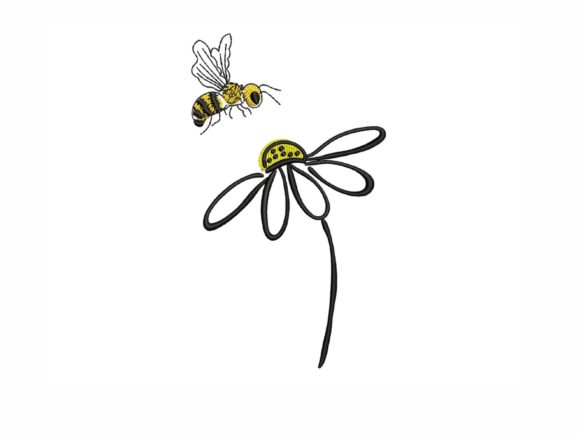
As an embroidery designer who’s packed, stitched, and sold at over 47 craft fairs—and watched thousands of shoppers pause at my booth—I’ll tell you straight: Bee and Daisy isn’t just another single flower design. It’s a quiet confidence-builder for handmade product lines. From the moment I read “simple and pretty” and pictured that daisy with its cheerful bee companion, I knew this was one of those rare machine embroidery designs that balances sweetness with sophistication—no cloying cuteness, no forced whimsy, just natural charm that reads clearly at three paces.
First Impression: Soft Farmhouse Meets Modern Minimal
Bee and Daisy lands squarely in the soft farmhouse–modern minimal sweet spot—a goldilocks zone for craft fair buyers. It’s not rustic enough to feel dated on a linen tea towel, nor so sleek it loses warmth on a cotton apron. The pairing suggests gentle playfulness (the bee), grounded by quiet elegance (the daisy). That duality makes it instantly legible as both a handmade product and a thoughtful gift—especially for gardeners, teachers, new moms, or anyone drawn to nature-inspired small shop products.
Where Bee and Daisy Shines in Real Booth Displays
I tested Bee and Daisy across eight craft fair staples—and here’s where it truly earned its spot on my front-row tote bag rack:
- Tote bag design: Centered on a natural canvas tote, it reads as premium—not busy, not tiny. At 3.5" wide, it anchors the bag without dominating. Customers consistently picked up these first.
- Apron embroidery: Positioned just above the pocket, it adds personality without interfering with function. Works equally well on denim, linen, and unbleached cotton.
- Tea towel embroidery: This is where Bee and Daisy becomes magic. On a folded, textured flour sack towel, the design pops with tactile contrast—the bee’s wings catch light, the daisy center holds shape even after washing.
- Embroidered patch: As a sew-on or iron-on, it’s highly giftable. Small shop owners love bundling these with seed packets or honey jars.
- Pillow cover & fabric pouch: Scales beautifully up to 4.25" without losing delicacy. On linen-look pillow covers, it feels intentional—not like filler.
It underperforms only where clarity suffers: curved cap surfaces (unless resized and rehooped carefully) and ultra-dense fabrics like thick twill. More on that below.
What Makes Bee and Daisy Sell—Beyond Cuteness
Sales don’t hinge on “adorable.” They hinge on readability, repeatability, and resonance. Bee and Daisy delivers all three:
- At-a-glance understanding: No decoding needed. A bee + daisy = nature, growth, joy. Perfect for time-crunched craft fair shoppers scanning dozens of booths.
- Batch-friendly scaling: Whether stitched at 2.75" on a patch or 4" on a market bag, proportions hold. That means consistent branding across your Etsy listings and physical display.
- Photogenic clarity: It photographs cleanly—even on dark fabric—when thread colors are chosen thoughtfully (more on contrast below). That translates directly to stronger printable mockups and higher-converting digital embroidery file listings.
Careful-Use Notes Every Embroidery Designer Should Know
This isn’t a “set-and-forget” embroidery file. To protect your reputation—and avoid booth-day stitch-outs—treat Bee and Daisy with precision:
- Dense stitch areas: The daisy center and bee thorax pack more density than the petals or wings. Use medium-weight cutaway stabilizer on knits or stretchy fabrics; skip tear-away on textured towels.
- Small details matter: The bee’s antennae and petal tips can vanish on dark fabric or low-thread-count cotton. Always test with your intended thread colors—especially if using variegated or matte threads.
- Fabric texture is non-negotiable: On heavy terry cloth or looped jacquard tea towels, reduce density slightly or increase stabilizer layers. Otherwise, the bee’s wing veins blur.
- Hoop size awareness: Confirm the largest version fits your standard hoop before batching. If it pushes 5", you’ll need rehooping on larger items—slowing production.
- Commercial embroidery use: Since this is marketed as a machine embroidery design for handmade product creation, verify licensing terms before selling finished goods—especially if listing on Etsy or wholesale platforms.
Design Assets That Build Your Brand—Not Just Your Booth
Bee and Daisy strengthens your brand because it’s versatile *and* distinctive. Unlike generic florals, it carries subtle narrative weight—the bee implies care, pollination, community. That subtext resonates with conscious shoppers. When repeated across your line (tote → apron → patch → pouch), it builds visual cohesion without monotony. And unlike trend-heavy motifs, it won’t feel dated next spring.
For Etsy sellers, pair it with clean, earth-toned printable mockups. For boutique makers, stitch it onto limited-edition linen bundles. For Cricut crafters adding embroidery accents, use it as a focal point beside heat-transfer vinyl text—just keep spacing generous so the bee doesn’t get visually crowded.
My Final Designer Checklist Before Booth Day
I never run Bee and Daisy live without doing these six things:
- Test-stitch on scrap fabric matching my final product (e.g., unbleached canvas for totes, flour sack for towels).
- Check thread contrast—especially on dark or heathered fabric—using actual spools, not screen previews.
- Review spacing between elements: Is the bee hovering naturally? Do petals breathe?
- Confirm hoop size compatibility across all planned products—no last-minute redesigns.
- Inspect stitch density: Does the center feel solid but not stiff? Do wings look airy, not jagged?
- Create one real-world mockup—photographed in natural light—to gauge booth impact and online listing appeal.
And yes—I always compare how it looks on three fabric colors: cream, sage, and charcoal. Because Bee and Daisy doesn’t just live on fabric. It lives in perception—and perception sells.
If you’re curating a collection of Single Flowers for your embroidery business—or building a cohesive line of commercial embroidery offerings—Bee and Daisy earns its place not as filler, but as a quiet anchor. It’s the kind of machine embroidery design that makes customers say, “I *need* that for my kitchen,” then turn around and buy two more for gifts. In craft fair economics, that’s not charm—it’s conversion.