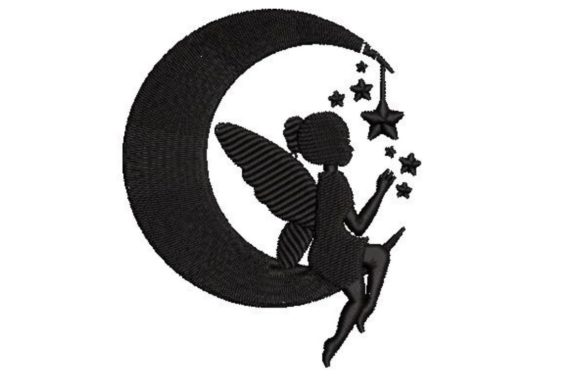
Silhouette of a Fairy Sitting
A Quiet Kind of Magic—Not Flashy, But Thoughtful
When I opened Silhouette of a Fairy Sitting for the first time, I didn’t see glitter or wings bursting with detail—I saw intention. It’s a single, clean profile: a small figure seated cross-legged, arms resting gently on knees, head tilted just slightly upward. There’s no facial detail, no overt sparkle—but that’s the strength. This isn’t a cartoon fairy; it’s a quiet, contemplative motif that leans into suggestion rather than spectacle. For embroidery designers and craft business owners, that subtlety is gold. It reads as handmade, not mass-produced—and that matters when you’re stitching baby onesies for boutique clients or embroidering linen tea towels for Etsy.
Where It Lives Best—Real Projects, Not Just Mockups
Last week, I stitched Silhouette of a Fairy Sitting onto a natural cotton tote bag for a local children’s bookstore launch. No appliqué, no extra layers—just the design centered on the front panel in soft heather gray thread. The result? Customers paused. They didn’t say “cute”—they said “peaceful,” “gentle,” “like something from a bedtime story.” That’s the mood this design carries: calm enchantment. It fits naturally on nursery wall hangings, organic-cotton swaddle blankets, linen pillow covers for kids’ rooms, and even minimalist aprons for small-batch bakeries leaning into whimsical branding.
It also works beautifully as an embroidered patch—stitched cleanly on twill, then heat-applied to denim jackets or backpacks. Because the outline is smooth and uncluttered, it holds up well at 3–4 inches wide without losing legibility. For sweatshirt embroidery, I recommend placing it low on the left chest or centered on the back yoke—not too high, where sleeve movement could distort the shape over time.
Where to Proceed With Care
- Small hoop sizes: The design reads clearly down to ~2.5”, but below that, subtle curves (like the gentle arch of the back or the curve of the knee) start to flatten. If you’re stitching caps or tiny baby hats, test first—and consider simplifying the inner line work manually if needed.
- Textured or stretchy fabric: On terry cloth towels or ribbed knit onesies, the silhouette can blur slightly unless you use medium-weight cutaway stabilizer + a light tear-away top layer. Don’t skip the stabilizer—it’s not optional here.
- Dark or dense backgrounds: Because it’s a silhouette, contrast is everything. On navy or charcoal, use bright ecru, pale gold, or ivory thread—not white. On light linens, deep moss green or slate blue adds quiet sophistication.
- Frequent-wash items: Baby clothes and kitchen towels demand durability. Check stitch density before finalizing—tight fill areas near the base should be balanced, not overly dense. Over-stitching risks puckering on thin cottons.
What It Does for Your Craft Business—Beyond Aesthetics
As an Etsy seller and custom apparel designer, I’ve learned that customers don’t just buy embroidery—they buy feeling, trust, and intention. Silhouette of a Fairy Sitting supports that. Its simplicity makes it easy to pair with handwritten names or short phrases (“Dream Deep,” “Little One,” “Nursery Days”) without visual competition. That means faster mockup creation, cleaner printable mockups for your listings, and higher perceived value on personalized gifts.
It also scales well across product types: one digital embroidery file becomes a cohesive collection—baby onesie + matching burp cloth + wooden name plaque + embroidered sachet. That consistency builds brand recognition for small shop owners without needing multiple designs. And because it avoids clichés (no wands, no oversized wings), it feels fresh next to other Fairy Tales-themed assets—especially when used alongside botanical motifs or muted palettes.
Designer Notes You’ll Actually Use
- Always test on scrap fabric first—especially if stitching on bamboo blends or brushed cotton. Silhouettes rely on clean edges, and those can fray or bleed without proper stabilization.
- Review thread color contrast in both light and dark mockups. What reads softly on cream may vanish on oatmeal. Try stitching a 1” square in your intended thread on your target fabric before committing.
- Check the inner line work. Some versions of silhouette-based machine embroidery designs include unnecessary running stitches inside the shape. If yours does, delete them—they add no value and increase stitch count unnecessarily.
- Confirm licensing before selling finished products. Since this is marketed as a commercial embroidery file, verify whether resale of stitched items is permitted—and whether digital redistribution (e.g., bundling with other designs) is allowed.
- Use it in black-and-white previews. If your Etsy thumbnails or social posts are often viewed in grayscale, this design holds up better than busy, multi-element fairy motifs.
Final Thought: Less Is More—Especially When It’s Handmade
I won’t pretend Silhouette of a Fairy Sitting is a showstopper for festival merch or bold streetwear. But for makers who value quiet craftsmanship—those stitching heirloom baby blankets, curating thoughtful nursery decor, or building a small shop around slow, intentional design—it lands with sincerity. It doesn’t shout. It invites. And in a market flooded with hyper-detailed, over-digitized embroidery files, that restraint is rare—and valuable. Use it where attention spans are short but emotional resonance matters: on a gift tag, a tea towel folded beside a handmade candle, or the inside hem of a child’s favorite dress. That’s where magic lives—not in flash, but in stillness.