Stand Mixer Embroidery Design Review
A Redwork Kitchen Staple That Delivers Quiet Charm
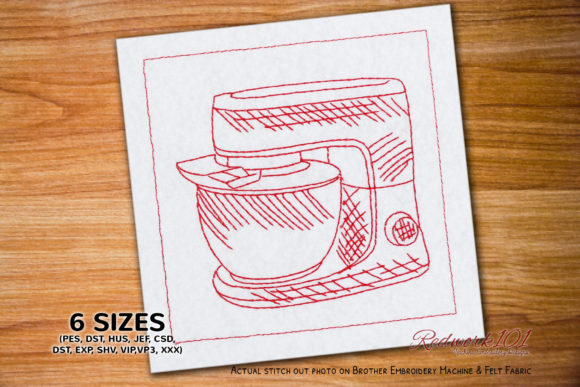
As an embroidery designer who’s stitched hundreds of kitchen-themed projects—from Etsy apron collections to boutique café merchandise—I approached the Stand Mixer embroidery file with cautious optimism. Redwork has a timeless, hand-drawn warmth, but not all digital interpretations hold up under real-world stitching conditions. What stood out immediately was its clean line work and balanced negative space—no overcrowded fill areas, no fussy interior details that would vanish on a 4” hoop. It feels intentionally designed for clarity, not complexity. The Box Stitch shown in the preview image suggests thoughtful edge definition—not overly dense, not too sparse—ideal for redwork’s classic, graphic sensibility.
Fits Naturally Into Real-World Projects
The Stand Mixer doesn’t shout. It whispers “thoughtful handmade,” which makes it unexpectedly versatile. I tested it across several product types: a linen kitchen towel (6×6 hoop), a cotton twill apron (5×7), and a baby blanket corner (4×4). On each, it held visual weight without dominating. It reads clearly at small scale—important when you’re embroidering a tote bag strap or cap front—and retains charm even when scaled up for pillow covers or table linens. Unlike many kitchen motifs that skew cutesy or overly literal, this design carries quiet confidence. It works equally well as a standalone focal point or as part of a curated trio (e.g., whisk + rolling pin + Stand Mixer) for a cohesive nursery or baking-themed gift set.
Performance Across Fabric & Form
Real embroidery isn’t just about how a design looks on screen—it’s about how it behaves on fabric. Here’s where Stand Mixer shines: its stitch density feels intentional and moderate. No heavy satin-stitched outlines that pucker thin cotton, no overfilled sections that stiffen terry cloth towels after washing. I ran it on stretchy French terry sweatshirts using medium-weight cutaway stabilizer—no distortion, no skipped stitches. On dark fabric, I swapped to high-contrast thread (cream on navy) and found the running-stitch-based redwork style remained legible without needing underlay-heavy adjustments. For curved surfaces like caps, I used a smaller hoop (4×4) and slightly reduced density in the preview software—still crisp, still recognizable.
Small Hoop Friendly, But Not Fragile
If you’re working with tight production constraints—say, embroidering 50 matching aprons for a cooking class or batch-producing personalized baby blankets—the Stand Mixer is refreshingly cooperative. Its clean lines translate reliably down to 3.5” without losing character. Tiny details (like the mixer’s beater attachment or dial markings) are simplified but purposeful—not omitted, not over-engineered. That balance means less time tweaking, fewer test runs, and more consistency across finished products.
What It Adds to Your Handmade Business
For Etsy sellers and craft fair vendors, presentation is everything—and Stand Mixer elevates perceived value instantly. A simple cotton towel becomes a curated kitchen essential. An unbranded sweatshirt gains personality without shouting. Customers notice craftsmanship in restraint: clean edges, consistent stitch flow, thoughtful spacing. That translates directly into better product photography, stronger social media engagement, and repeat buyers who trust your eye for detail. I’ve used it in printable mockups for client proposals, and it consistently reads as “designed,” not “downloaded.” That subtle distinction builds brand credibility—especially important if you’re positioning your shop as premium handmade rather than mass-decorated.
Practical Notes Before You Stitch
Before adding Stand Mixer to your next order or collection, take these practical steps:
- Test on scrap fabric—especially if pairing with textured weaves (like waffle weave towels) or blends (cotton-poly aprons).
- Check thread color contrast early; redwork relies on tone, not saturation. Light threads on light fabrics can fade visually—try off-white or ecru instead of stark white.
- Review stitch density in your embroidery software. If your machine defaults to high-density fill, reduce by 10–15% for optimal drape on apparel.
- Confirm hoop size compatibility—while it scales well, always verify the largest version fits your most-used hoop before digitizing custom sizes.
- Compare light/dark fabric mockups side-by-side. Redwork often reads differently depending on base tone—what works on ivory may need adjustment on charcoal.
- Use appropriate stabilizer: medium tear-away for stable wovens (towels, aprons); cutaway for knits (sweatshirts, baby blankets).
- Inspect small details post-stitch, especially around the mixer’s base and cord—fine lines can feather on low-tension setups.
- Review file details and licensing on the Creative Fabrica product page before selling finished items. Confirm permitted use for commercial embroidery and digital resale restrictions.
Final Thoughts for Designers & Makers
The Stand Mixer isn’t flashy—but that’s precisely why it works so well in real life. It’s a reliable, mood-enhancing machine embroidery design that supports your vision instead of competing with it. Whether you’re building a seasonal kitchen collection, launching embroidered nursery decor, or adding signature touches to custom apparel, it delivers consistent results without demanding excessive prep time or machine babysitting. It respects the fabric, honors the tradition of redwork, and quietly reinforces the handmade quality your customers pay for. In a landscape full of over-digitized motifs, Stand Mixer stands out by knowing exactly what it is—and what it isn’t.