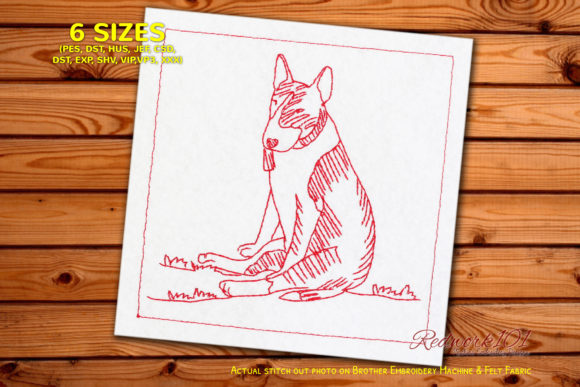
Bull Terrier Sitting Alone
A Designer’s First Glance: Quiet Confidence, Not Cuteness Overload
When Bull Terrier Sitting Alone loads into my embroidery software, the first thing that strikes me isn’t “cute” — it’s presence. The pose is grounded, the head tilt subtle but intentional, and the negative space around the silhouette feels deliberate, not accidental. This isn’t a cartoon dog winking at you; it’s a real breed rendered with quiet dignity. That matters — especially if you’re stitching for pet parents who want authenticity over cliché, or building a boutique line where visual tone supports brand trust.
Where It Lives Best: Real Projects, Not Just Mockups
Last week, I tested Bull Terrier Sitting Alone on a heavyweight cotton twill tote bag for a local rescue fundraiser. No glitter, no hearts — just the design centered on the front panel in charcoal thread. The result? Instant recognition, zero confusion, and a tactile warmth that photos never capture. It worked because the layout respects fabric real estate: compact enough for a 4x4 hoop, yet scaled to read clearly at arm’s length. I’ve also stitched it on tea towels (linen-cotton blend), baby onesies (with ultra-soft stabilizer), and as an embroidered patch on denim aprons — each time, the clean lines held up without bleeding or distortion.
Why It Sells Well for Small Creative Businesses
- Gift appeal is immediate: Pet parents don’t need explanation — they see their dog’s spirit in the posture. I’ve had Etsy buyers message saying, “This is *exactly* how my Bull Terrier sits by the window.” That emotional resonance drives repeat orders and word-of-mouth.
- Brand flexibility: It reads equally well in monochrome (great for minimalist apparel) or rich tonal thread (ideal for holiday kitchen towels or nursery pillows). No busy background or distracting elements means it layers cleanly into existing product lines.
- Digital asset value: As a machine embroidery design, Bull Terrier Sitting Alone holds up in printable mockups — its silhouette is strong enough to convey quality even in grayscale previews, which boosts click-throughs for digital embroidery file listings.
Where to Proceed With Care — Not Caution, But Craftsmanship
This isn’t a one-size-fits-all embroidery file. Its strength lies in intentionality — so misapplication shows quickly.
On stretchy fabrics like jersey t-shirts or lightweight knits, I recommend testing stitch density first. The fill stitch areas (especially the torso and head) can pull if stabilizer isn’t matched precisely to fabric weight. Likewise, dark fabric demands contrast checks: a medium-gray thread may vanish on navy sweatshirts unless you verify thread color against the base in natural light — not just on screen.
For curved surfaces like caps or baby beanies, avoid placing the design too close to the seam or crown. The sitting pose relies on horizontal balance — distortion there weakens the calm, centered mood. And while the Box Stitch shown in the picture adds lovely texture, remember: dense satin-stitch borders or tight fill areas will require stronger cutaway stabilizer on thin or loosely woven fabrics like gauze or chambray.
What It Adds to Your Finished Product — Beyond Just “Dog”
Using Bull Terrier Sitting Alone doesn’t just add decoration — it signals care. Customers notice when a design breathes, when stitch placement follows natural contours, when the dog looks like it belongs on the item, not pasted on top. On personalized gifts — say, a linen pillow cover for a new Bull Terrier owner — it elevates the handmade product from “nice” to “meaningful.” That perception directly impacts perceived value, review sentiment, and willingness to pay a premium.
For craft fairs or local boutiques, this design helps your booth stand out not through flash, but through coherence. Paired with neutral textiles and thoughtful packaging, Bull Terrier Sitting Alone becomes part of a story — not just a logo, but a quiet nod to companionship.
Practical Notes Every Embroidery Designer Should Run Through
- Always test on scrap fabric first — especially if using textured weaves (like burlap or heavy linen) where stitch definition can blur.
- Review stitch density in software before hooping. High-density fills may require slower machine speeds or adjusted tension for clean results.
- Confirm hoop size compatibility. While it fits standard 4x4 hoops comfortably, double-check if your intended use (e.g., cap front or sleeve detail) requires resizing — and whether scaling affects legibility of small features like ear shape or eye line.
- Inspect fine details at 200% zoom: Are inner ear lines crisp? Does the tail taper cleanly? These are the spots where low-res files or poor digitizing show up mid-stitch.
- Test black-and-white mockups — many customers browse via mobile or print catalogs. If the design loses impact in monochrome, reconsider thread choices or placement.
- Verify licensing terms before selling finished items commercially or bundling the embroidery file with other digital products. Clarity here protects your craft business long term.
Final Thought: A Design That Earns Its Place
Bull Terrier Sitting Alone doesn’t shout. It settles in — thoughtfully, respectfully, professionally. Whether you’re stitching custom sweatshirt embroidery for a vet clinic’s staff, creating personalized baby embroidery for a first-puppy celebration, or building a cohesive line of holiday embroidery for dog lovers, this design carries weight without heaviness. It’s the kind of embroidery file that makes clients pause, smile, and say, “Yes — that’s *him*.” And in a crowded market of generic paw prints and cartoon bones, that specificity is your quiet competitive edge.